Showing posts with label CIRCA 1960'S. Show all posts

Friday, September 16, 2011

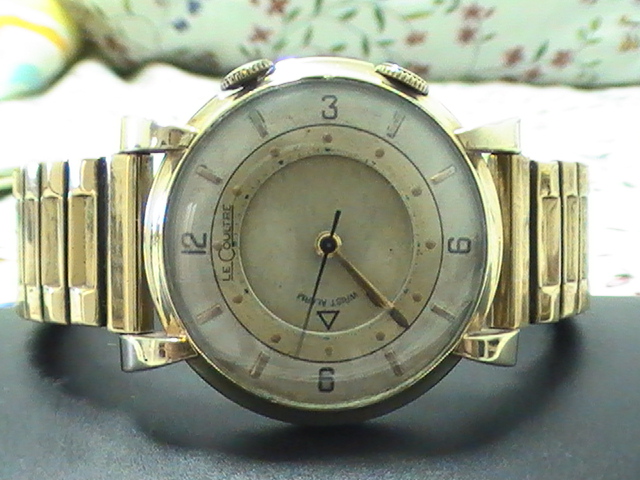
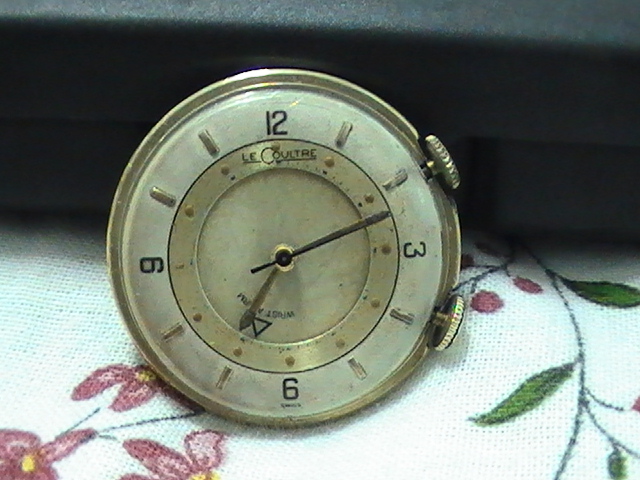
AUTHENTIC JAEGER LE COULTER WRISTALARM (EALIER MEMOVOX) GENTS WRISTWATCH


BRAND/JENAMA: AUTHENTIC VINTAGE 10K GOLD FILLED LECOULTRE WRISTALARM (EALIER MEMOVOX) GENTS WRISTWATCH

MADE IN/BUATAN: SWISS

CIRCA/TAHUN: 1960's

MODEL: POWER RESERVED

CRYSTAL/CERMIN: ACRYLIC

MOVEMENT/ENJIN: LECOULTRE 17 JEWELS MANUAL MOVEMENT CAL.411

DIAL COLOR: CHAMPAGNE

FUNCTION/FUNGSI: HOUR, MINUTE, SECOND AND ALARM DISC

HANDS/JARUM: GOLD TONE

MARKERS/TANDA WAKTU: GOLD TONE STICKS AND ARABIC MARKERS

CASING : 10K GOLD FILLED

LUGS: 16mm UNUSUAL LOGS LUGS

MEASUREMENT/UKURAN: 34mm DIAMETER INCLUDING CROWN and 37mm LUG TO LUG

BEZEL: 10K GOLD FILLED BEZEL

DITANDA/ENGARVED BACK CASING: -

CROWN: UNSIGNED ORIGINAL CROWN

STRAP/TALI: 10K GOLD FILLED SPIEDEL BAND

SIZE STRAP/SAIZ TALI: 9.5" FULL LENGHT

DISCONTINUED LECOULTRE MODEL... RARE BUMPER MODEL!

EXCELLENT CONDITION, KEEPING GOODTIME AND ALARM BUZZING LOUDLY

PRICE/HARGA: RM2,500 (NEGOTIABLE)

A BRIEF HISTORY OF LE COULTRE WATCHES

A brilliant inventor and self-taught watchmaker, Antoine-LeCoultre founded his first workshop in 1833, following the invention of a machine to produce watchmaking pinions. Ever since, the Manufacture Jaeger-Lecoultre has developed constantly around the founder's original workshops.

Surprisingly enough, it was neither a physicist nor an engineer who first measured the micron; it was Antoine LeCoultre, in 1844. He had created watch components that were so perfect no tool could actually detect their degree of inaccuracy. He followed that up by inventing the world's most accurate instrument: the Millionometer, which served as a benchmark for over half a century.

In 1847, LeCoultre created a revolutionary system that was to do away with the need for keys to rewind and set watches. His simple and brilliant solution was a pushbutton that activated a lever to switch from one function to another. It was the first keyless winding mechanism, and the first reliable system that eliminated the need for keys to wind or set a watch.

In 1866, when Swiss watchmaking was still structured around small home-run workshops, Antoine LeCoultre and his son Elie decided to bring together under one rood the many skills involved in making watches, and installed a steam-driven machine to operate their new tools. LeCoultre & Cie thus became the first Manufacture in the Vallée de Joux.

It was in 1903 when the Parisian Edmond Jaeger set Swiss watchmakers the challenge of producing ultra-thin calibres. It would lead to the Calibre 145, the world's thinnest mechanical movement, measuring no more than 1.38 mm, and the friendship of Antoine LeCoultre's grandson, Jacques-Devid LeCoultre. These two men would give a rise to a range of horological wonders, and eventually the birth of the Jaeger-LeCoultre brand in 1937.

In the year 1908, the Manufacture created its first rectangular-shaped calibre in response to the challenge created to miniaturize watches to wear on the wrist. By the "Roaring 20s" (1920s), very small ladies' wristwatches were all the rage, but extreme miniaturization always led to a loss of reliability and precision. The Duoplan brilliantly solved this problem by arranging its parts on split levels. It would lead to the world's smallest movement, Calibre 101. Outdoing the Calibre 145, Jaeger-Lecoultre miniaturized the Duoplan caliber to the extreme, weighing in at barely one gram and comprising of 74 parts. Its record is still unmatched to this date.

Since its founding, the Manufacture has created and produced over 1,000 different calibres in many varieties. Over 200 patented inventions have contributed to the progress of Swiss watchmaking in the field of movements, as well as that of cases, bracelets, dials, and watch functions.


Saturday, August 27, 2011

RARE COLLECTION - ROLEX SOLAR AQUA GENTS WRISTWATCH


VERY RARE VINTAGE AUTHENTIC ROLEX SOLAR AQUA GENTS WRISTWATCH

MADE BY ROLEX FOR EATONS FOR CANADIAN MARKET

CRYSTAL IS CLEAN WITH NO CRACK OR SCRATCHES

THE 17 RUBIES ROLEX TUDOR SOLAR AQUA AUTOMATIC MOVEMENT

GOLD CHAMPAGNE DIAL - NO DATE

GOLD TONE DAUPHINE HANDS

GOLD TONE RAISED ARROW HEAD AND ARABIC MARKER

CASE MEASURES APPROXIMATELY 34mm EXCLUDING THE CROWN AND 41mm LUG TO LUG

GENUINE LOCK DOWN ROLEX GOLD PLATED CROWN MARKED OYSTER PATENTED

NEW GENUINE BROWN LEATHER BAND FITS 8.5" WRIST

DISCONTINUED MODEL... VERY RARE!

EXCELLENT CONDITION, KEEPING TIME AND RECENTLY SERVICED

PRICE : RM6850.00 (NEGOTIABLE)


EATON'S IS A SOLE AGENTS FOR ROLEX WATCHES FOR CANADIAN MARKET. SOLAR WATCHES ARE EATON'S HOUSEHOLD BRAND. SOME OF THE SOLAR WATCHES WERE PRODUCED BY ROLEX SUCH AS SOLAR AQUA OYSTER WHICH IS SOUGHT AFTER BY MANY WATCH COLLECTOR.

Saturday, August 13, 2011

VERY RARE VINTAGE X ROLEX UNICORN LADIES WRISTWATCH


BRAND/JENAMA: VINTAGE UNICORN LADIES WRISTWATCH

CIRCA/TAHUN: 1960's

MODEL: DRESS

CRYSTAL/CERMIN: ACRYLIC - CLEAN

DIAL: TEXTURED CHAMPAGNE

MOVEMENT/ENJIN: SWISS UNICORN 17 JEWELS MANUAL WINDING MOVEMENT

HANDS/JARUM: GOLD TONE/ KEEMASAN

MARKERS/TANDA WAKTU: RAISED ARABIC AND STICKS

CASING : GOLD TOP & STAINLESS STEEL BACK

MEASUREMENT/UKURAN: 18m DIAMETER W/O CROWN AND 28mm LUG TO LUG

DITANDA/ENGARVED BACK CASING: " NONE"

CROWN: ORIGINAL GP CROWN

STRAP/TALI: ORIGINAL DOUBLE LAYER TEXTILE ROPE WITH GOLD FILLED BUCKLE - FULL LENGTH

DISCONTINUED MODEL... VERY RARE AND HARD TO FIND!

EXCELLENT CONDITION, KEEPING TIME

PRICE: RM450 (NEGOTIABLE)


In the 1920s and 30s, Rolex has numerous secondary brands, similar to what the Tudor brand is today. One of those brands was the Unicorn. You may find these wrist and pocket watches with an unsigned dial, but Unicorn signed movement, For those of you unfamiliar with the name Unicorn, please see Cooksey Shugart's Complete Price Guide to Watches. At the back of the Rolex section is a partial list of brands that Rolex once distributed, as Rolex either set up or bought subsidiary companies with names like Bucherer, Marconi, Rolco, Genex, Unicorn.


This Unicorn watch casing was produced by RWAG (Rolex Watch AG) Germany, a subsidiary company of Rolex Watch Company (RWC). In 1960's Unicorn watch was no longer under Rolex SA

VERY RARE VINTAGE X ROLEX UNICORN LADIES WRISTWATCH


BRAND/JENAMA: VINTAGE UNICORN LADIES WRISTWATCH

CIRCA/TAHUN: 1960's

MODEL: DRESS

CRYSTAL/CERMIN: ACRYLIC - CLEAN

MOVEMENT/ENJIN: SWISS UNICORN 17 JEWELS MANUAL WINDING MOVEMENT

HANDS/JARUM: GOLD TONE/ KEEMASAN

MARKERS/TANDA WAKTU: RAISED ARABIC AND STICKS

CASING : GOLD TOP & STAINLESS STEEL BACK

MEASUREMENT/UKURAN: 18m DIAMETER W/O CROWN AND 28mm LUG TO LUG

DITANDA/ENGARVED BACK CASING: " NONE"

CROWN: ORIGINAL GP CROWN

STRAP/TALI: ORIGINAL DOUBLE LAYER TEXTILE ROPE WITH GOLD FILLED BUCKLE - FULL LENGTH

DISCONTINUED MODEL... VERY RARE AND HARD TO FIND!

EXCELLENT CONDITION, KEEPING TIME

PRICE: RM450 (NEGOTIABLE)


In the 1920s and 30s, Rolex has numerous secondary brands, similar to what the Tudor brand is today. One of those brands was the Unicorn. You may find these wrist and pocket watches with an unsigned dial, but Unicorn signed movement, For those of you unfamiliar with the name Unicorn, please see Cooksey Shugart's Complete Price Guide to Watches. At the back of the Rolex section is a partial list of brands that Rolex once distributed, as Rolex either set up or bought subsidiary companies with names like Bucherer, Marconi, Rolco, Genex, Unicorn.


This Unicorn watch casing was produced by RWAG (Rolex Watch AG) Germany, a subsidiary company of Rolex Watch Company (RWC). In 1960's Unicorn watch was no longer under Rolex SA

Wednesday, August 10, 2011

RARE COLLECTION ~ 14K SOLID GOLD VACHERON CONSTATIN LE COULTRE GENTS DRESS WATCH


Movement- LeCoultre, manual wind by Vacheron Constatin which clearly marked VXN on the movement

Caliber- 417/30W

Case- Solid 14K Gold, 34.5mm (not including crown), 18mm between lugs, Dial- Champagne, signed LeCoultre (with logo), seconds subdial

Crown- Silid 14K Gold

Serial Number- 1107469


PRICE - RM4.2K NEGOTIABLE


HISTORY OF VACHERON CONSTATIN (VC) AND JAEGER-LECOULTRE (JLC)

1938 after years of close cooperation, LeCoultre takes a partial ownership position, and a Jaeger-LeCoultre marketing alliance is formed.

Jaeger's Swiss sales organization were moved into the VC business address in Geneva

1940 George Ketterer, through SAPIC, takes a majority shares position in VC. Ketterer was Managing Director at SAPIC, which was the holding company for Le Coultre, Jaeger-Le Coultre, and a majority shareholder of VC; he was also a Manager in VC. There was a Ketterer in charge at VC - either George or his son Jacques - until 1987.

1940-1950's VC's operational role became etablisseur to LeCoultre's manufacture

1944 The caliber 2003 is announced - 1.64mm thinnest manual wind in history - by AP, and VC participates in a similar announcement.

1946 AP ships the finished Ultra Thin based on the cal. 2003 (AP company literature, No. 1, 2000)

1950's US importer was VC-Le Coultre, which was itself a division of Longines Wittnauer Watch Co

1955 VC 200 year bicentennial -

VC releases Ultra Thin announced in 1944 as a 200 year anniversary piece. Vacheron claim several advanced features not claimed by AP for the cal. 2003, including unique escapement and regulator innovations, which allowed for the elimination of shock protection and the elimination of adjustment normally required after cleaning and lubrication.

VC presented to Bulganin (Soviet Union), Eden (Great Britain), Eisenhower (USA), Faure (France)

1965 George Ketterer left Jaeger LeCoultre and went to head VC, thus separating the LeCoultre ownership connection.


Saturday, August 6, 2011

RARE SWISS MADE GRUEN GENTS AUTOMATIC WRISTWATCHES COLLECTION


Gruen GULDITE Precision Autowind 35x38mm, manual winding 17 Jewel Cal. 516SS- RM950

Gruen PRECISION AUTOWIND 38x42mm, manual winding 25 Jewel Cal. 03- RM600

Gruen Precision Veri-thin Auto Bumper Sub Second 36x41mm, 17 Jewel Cal. 460- Auto not functioning -manually wind - Personal collection


Gruen PRECISION AUTOWIND 34x39mm, manual winding 25 Jewel Cal.551- RM800


Gruen PRECISION AUTOWIND DAYDATE 68x42mm, 17 Jewel Cal.33 - RM850


Gruen PRECISION AUTOWIND 36x42mm, 17 Jewel Cal.550SS - RM950


TRADED WITH MR KAMARUL FROM CHERAS, KUALA LUMPUR

BRIEF HISTORY OF GRUEN WATCHES


The first Gruen watches are of very high quality and are beautifully made. Both 18 and 16 size versions were manufactured, each in both open face and hunter styles, and in 18- and 21-jewel versions. The earliest D. Gruen & Son serial numbers started around 62000. The Gruens dealt directly with individual jewelry stores; there were no wholesalers or jobbers involved in the distribution of their watches.


In 1898 George Gruen joined the firm as treasurer and financial officer. The company incorporated and its name changed to D. Gruen, Sons & Company.


In 1903 Gruen introduces its "VeriThin" line of watches.


In 1908 Gruen introduced both men's and women's wristwatches. These proved popular only with women. Gruen was one of a very few companies to take wristwatches seriously this early, seeing their potential in spite of disappointing early sales to male customers.


Gruen made both wrist and pocket watches for the military during World War I. Most had silver cases, which would tarnish but would not corrode under adverse conditions. To satisfy U.S. military regulations, these watches all have luminous dial markings and hands.


1911 Dietrich Gruen dies suddenly. Fred Gruen takes control of the company.


In 1913 the company purchased Nanny Goat Hill, a pasture just outside of Cincinnati, and renamed it Time Hill. Work began on a new building designed by architect Guy C. Burroughs at a construction cost estimated at $50,000 USD. The company moved to the new location in 1917.


1921: Gruen introduces The Cartouche wrist watch calling it "The logical wrist watch shape".


1922: Gruen introduces "The Pentagon" pocket watch. "the Croix de Guerre of American achievement"


Up until 1922 there had actually been three Gruen companies: D. Gruen, Sons & Company; The Gruen National Watch Case Company of Cincinnati; and The Gruen Watch Manufacturing Company of Biel, Switzerland. In 1922 all three businesses were merged to form the Gruen Watch Company, with Fred as President.


In 1924, Gruen released a special pocket watch in an edition of 600 to commemorate their 50th anniversary. The watch cost $500 at the time.


In 1925, Gruen introduced the men's Quadron. These were rectangular watches containing very high-quality 15-j or 17-j tonneau-shaped movements.


In 1928 Gruen releases The Techni-Quadron. The famous Techni-Quadron "doctor's watches" are so-called because the large seconds dial was handy for timing a patient's pulse.


In 1935 Fred Gruen, now 63 years old, became Chairman of the Board and Benjamin S. Katz was brought in as President of the Gruen Watch Company. In 1935, Gruen was about $1.8 million USD (roughly $36 million USD today) in debt; nervous stockholders and investors were behind the change. Fred would retire in 1940, but continued to sit on the board for the rest of his life.


In 1935 Gruen introduces the most famous Gruen wristwatch- "The Curvex". These watches are one of the greatest examples of 1930s streamlined design.


1937: Gruen introduces "The Ristside" or "driver's" watches.


In 1938, continuing the success of their VeriThin pocket watches, Gruen also launched a series of Veri-Thin wristwatches. Contemporary Curvex and Veri-Thin movements often are closely related, and can share many parts. By the 1940s, most Gruen wristwatches were either Veri-Thin or Curvex models.


Although Gruen did not manufacture watches for the U.S. military, they offered the public a collection of eight military-style watches, to be used as personal watches.


In 1949, the company introduced their first watches made entirely in the U.S., a line of 21-jewel men's models called the "Gruen 21". The movements are marked "Cincinnati" or "US" instead of the usual "Switzerland."


Fred Gruen retired in 1940 and died in 1945, and his brother George died in 1952. In 1953 the Gruen family sold their interest in the company. The same year, Gruen president Benjamin Katz was forced into retirement after a scandal, and in 1954 the company bought out his shares for $2 million USD.


In 1953, the Gruen Watch Company had its highest sales in its entire history.


The Myth about Gruen, Rolex and Aegler - The True History


One of the most deeply-held myths about Gruen is that Gruen and Rolex at one time manufactured movements for each other's watches. Both firms did use some of the same movements—the best known examples are the Gruen Techi-Quadron and its twin, the Rolex Prince. In reality, these movements were manufactured by a third company, Aegler, who was a very close neighbor to the Gruen Precision Factory.

illustration of the Aegler building

Above: The Aegler factory in Biel. Aegler made movements for Rolex (which had no manufacturing capability at the time), and this building is the main Rolex factory today. Aegler was partly owned by Gruen.

Gruen and Rolex were Aegler's biggest customers, and were both large shareholders as well—the full company name at one time was, Aegler, Societe Anonyme, Fabrique des Montres Rolex & Gruen Guild A. Gruen and Rolex both occasionally showed pictures of the huge Aegler factory in their advertising, making the implication that this was a Gruen- or Rolex-owned facility, although ownership at the time was divided among Gruen, Rolex and Aegler itself. Gruen sold their Aegler shares in the 1930s, after they moved all production to the Precision Factory. After this time, Aegler became increasingly tied to Rolex through the sale of stock. Today, the main Rolex building in Biel is the old Aegler factory, and though it is now owned by Rolex, it is still run by the Aegler family.


This article taken from Complete Price Guide to Watches, American Wriswatches, Rolex Wristwatches: Best of Time and Gruen Master Book