Showing posts with label MANUAL. Show all posts

Friday, September 16, 2011

PREVIEW - STEINHAUSEN LEONARDO TW783G SKELETON GENTS WRISTWATCH


Swiss inventor and architect Ulrich Van-Heusen was a master craftsman who dedicated himself to his trade. He lived in an era when only the wealthy could afford a timepiece. But in 1923, Van-Heusen completed his first automatic calendar watch - only one of seven he ever completed. It displayed not only the time, but also the date, day and month; and it was the first to designate the difference between AM and PM. Van-Heusen named his brand Steinhausen after the region in Switzerland from where his family came. He was steadfast in his belief that wristwatches, not the prevalent pocket watch, would eventually become an item people could not live without. And he was correct! The Great Depression almost eliminated handmade watches of this quality. One that remains today fetched $300,000 at auction. Wristwatches became the must-have item for people of all social strata, but the distinguished gentry continued to buy Steinhausen's handcrafted marvels.

Steinhausen continues its reputation of producing the finest workmanship and classy designs. And now, we are pleased to re-introduce the original Steinhausen model with stylish updates. Like the original Steinhausen, each watch is painstakingly reproduced by hand from 185 genuine Swiss parts. Then it is so rigorously tested for two weeks that just six percent of movements made end up in a Steinhausen. Swiss automatic movement standards allow for an accuracy of +25/-27 seconds per day and the Steinhausen watches rate +15/-13 seconds per day, making it more accurate.

The Limited Edition Leonardo follows the tradition of displaying the movement through exhibition frontcase and backcase. The sweeping second-hand movement, brushed and polished stainless steel, and gold tone dial with Roman numerals is included, too. However, they added hand-cut precious sapphire gemstones from Vietnam to the buttons to add a rich luster, 21 jewels aid movement and accuracy; and interchangeable brown, black leather and gold/stainless steel wristbands to match whatever you're wearing.

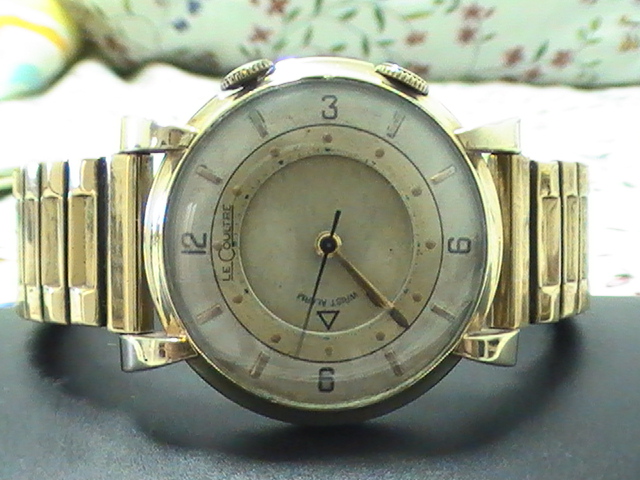
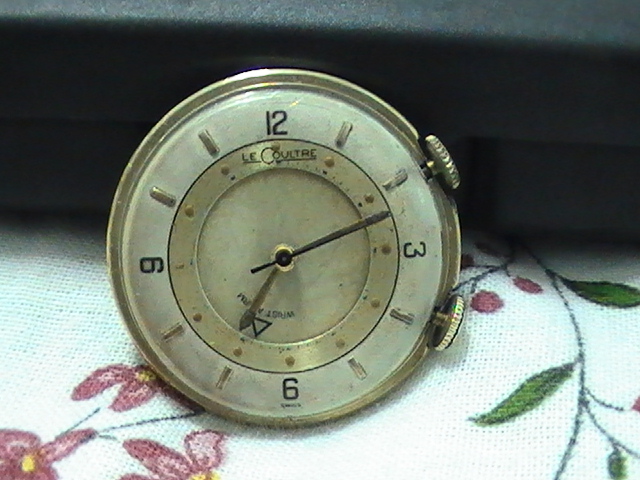
AUTHENTIC JAEGER LE COULTER WRISTALARM (EALIER MEMOVOX) GENTS WRISTWATCH


BRAND/JENAMA: AUTHENTIC VINTAGE 10K GOLD FILLED LECOULTRE WRISTALARM (EALIER MEMOVOX) GENTS WRISTWATCH

MADE IN/BUATAN: SWISS

CIRCA/TAHUN: 1960's

MODEL: POWER RESERVED

CRYSTAL/CERMIN: ACRYLIC

MOVEMENT/ENJIN: LECOULTRE 17 JEWELS MANUAL MOVEMENT CAL.411

DIAL COLOR: CHAMPAGNE

FUNCTION/FUNGSI: HOUR, MINUTE, SECOND AND ALARM DISC

HANDS/JARUM: GOLD TONE

MARKERS/TANDA WAKTU: GOLD TONE STICKS AND ARABIC MARKERS

CASING : 10K GOLD FILLED

LUGS: 16mm UNUSUAL LOGS LUGS

MEASUREMENT/UKURAN: 34mm DIAMETER INCLUDING CROWN and 37mm LUG TO LUG

BEZEL: 10K GOLD FILLED BEZEL

DITANDA/ENGARVED BACK CASING: -

CROWN: UNSIGNED ORIGINAL CROWN

STRAP/TALI: 10K GOLD FILLED SPIEDEL BAND

SIZE STRAP/SAIZ TALI: 9.5" FULL LENGHT

DISCONTINUED LECOULTRE MODEL... RARE BUMPER MODEL!

EXCELLENT CONDITION, KEEPING GOODTIME AND ALARM BUZZING LOUDLY

PRICE/HARGA: RM2,500 (NEGOTIABLE)

A BRIEF HISTORY OF LE COULTRE WATCHES

A brilliant inventor and self-taught watchmaker, Antoine-LeCoultre founded his first workshop in 1833, following the invention of a machine to produce watchmaking pinions. Ever since, the Manufacture Jaeger-Lecoultre has developed constantly around the founder's original workshops.

Surprisingly enough, it was neither a physicist nor an engineer who first measured the micron; it was Antoine LeCoultre, in 1844. He had created watch components that were so perfect no tool could actually detect their degree of inaccuracy. He followed that up by inventing the world's most accurate instrument: the Millionometer, which served as a benchmark for over half a century.

In 1847, LeCoultre created a revolutionary system that was to do away with the need for keys to rewind and set watches. His simple and brilliant solution was a pushbutton that activated a lever to switch from one function to another. It was the first keyless winding mechanism, and the first reliable system that eliminated the need for keys to wind or set a watch.

In 1866, when Swiss watchmaking was still structured around small home-run workshops, Antoine LeCoultre and his son Elie decided to bring together under one rood the many skills involved in making watches, and installed a steam-driven machine to operate their new tools. LeCoultre & Cie thus became the first Manufacture in the Vallée de Joux.

It was in 1903 when the Parisian Edmond Jaeger set Swiss watchmakers the challenge of producing ultra-thin calibres. It would lead to the Calibre 145, the world's thinnest mechanical movement, measuring no more than 1.38 mm, and the friendship of Antoine LeCoultre's grandson, Jacques-Devid LeCoultre. These two men would give a rise to a range of horological wonders, and eventually the birth of the Jaeger-LeCoultre brand in 1937.

In the year 1908, the Manufacture created its first rectangular-shaped calibre in response to the challenge created to miniaturize watches to wear on the wrist. By the "Roaring 20s" (1920s), very small ladies' wristwatches were all the rage, but extreme miniaturization always led to a loss of reliability and precision. The Duoplan brilliantly solved this problem by arranging its parts on split levels. It would lead to the world's smallest movement, Calibre 101. Outdoing the Calibre 145, Jaeger-Lecoultre miniaturized the Duoplan caliber to the extreme, weighing in at barely one gram and comprising of 74 parts. Its record is still unmatched to this date.

Since its founding, the Manufacture has created and produced over 1,000 different calibres in many varieties. Over 200 patented inventions have contributed to the progress of Swiss watchmaking in the field of movements, as well as that of cases, bracelets, dials, and watch functions.


Wednesday, August 31, 2011

PREVIEW - EXTREMELY VERY RARE HIGHLY COLLECTIBLE OMEGA CHRONOGRAPH 2668CK CAL.321 GENTS WRISTWATCH


RARE COLLECTION - OMEGA CHRONOGRAPH OMEGA 17 JEWELS MANUAL WINDING CAL.321 SERIAL NO. 32834987 CIRCA 1955, THE SAME HANDS AND THE SAME HIGH GRADE MOVEMENT USED IN OMEGA SPEEDMASTER PREMOON MODEL CK2915


The stainless steel case shows no wear, and it actually still retains the factory finish. It has not been cleaned up In the case just shy of 34mm diameter without winding crown push button, waterproof back type, plastic crystal, dial is original and has a great omega emblem raised to indicate higher grade.


The stainless steel case shows no wear, and it actually still retains the factory finish. It has not been "spiffed" or cleaned up in anyway. The case measures just shy of 34mm in diameter without the winding crown or push buttons. Waterproof snap-back type case back. The plastic crystal is excellent. The dial is 100% original and has a great patina.


The Omega emblem is raised to indicate a higher grade of watch. The Omega movement is Caliber 321 , 17 jewels chronograph. This movement is in excellent running order and the chronograph functions work perfectly. It is copper/rose finished. It has a fully compensated balance wheel. The movement Serial Number is 15147493


WILL KEEP IT AS MY PERSONAL COLLECTION BECAUSE OF DIFFICULTY TO FIND AND RARITY OF THIS WATCH BUT I'M WILLING TO PART WITH IT FOR RM18,500 AND NON NEGOTIABLE


THE MAGNIFICENT OF OMEGA CAL. 321
I had the pleasure of getting a look under the hood of Omega’s vintage chronograph calibre 321 which I just required time this week and was duly impressed. Predecessor to the now classic calibre 861, which earned its place in the history books as the movement which ran in the famed “First Watch Worn on the Moon”, I hadn’t heard much of it before. More than likely due to its age and the simple fact of it being lost in the shadow of its younger brother.


Unlike the 861 however, the 321 is the finest specimen of movement I have seen from this manufacture. Which came as quite a surprise to me. The 321 is a column wheel operated chronograph and boasts a Breguet overcoil, with guards fitted to the regulating pins to keep the hairspring from jumping out from between them should the watch be subjected to a strong shock. The 861 on, on the other hand, is more economically made, using a more easily mass produced cam to operate the chronograph, and doing away with the overcoil and guards. Even more unfortunate, is how much further removed the 321 is in quailty of crafstmanship from Omega’s calibre 1861, which replaced the 861.


Most noticeable is the substitution of rhodium plating in place of the rose gold plating that is employed on the 861 and 321. That, though, is of little consequence. In fact, I could say it is one point in favour of the 1861, as rhodium is more durable than gold. The value of either depends on one’s perspective. Both have their merits. The point, though, is moot when held against the quality of steel used in the 321 and 861. More correctly, it is the quality of finish of the steel, particularly at the pivots, where the older calibres outpace the new. The pivots in the 321 are so carefully burnished that they still hold such a silky, deep lustre, that they hardly look a day old once cleaned. I cannot say as much for Omega’s more recent chronographs.


Sunday, August 21, 2011

RARE COLLECTION - AUTHENTIC VINTAGE PATEK PHILIPPE GENTS WRISTWATCH


HIGHLY COLLECTABLE AND HARD TO FIND PATEK PHILIPPE GENTS WRISTWATCH - DRESS WATCH FOR GENTS CIRCA 1900'S

WHITE PORCELAIN DIAL

CRYSTAL IS CLEAN WITH NO CRACK OR SCRATCHES

EXTHIBITION CASE BACK

SOLID STAINLESS STEEL RE-CASED

EXTREMELY GORGEOUS COSMETICALLY (SEE PHOTOS)

THE 18 JEWELS WOLF TEETH PATEK PHILIPPE MANUAL MOVEMENT S/N 80,772 made for Shreve, Crump & Low Co

BLACK METAL HANDS

BLACK ARABIC MARKER

CASE MEASURES APPROXIMATELY 36mm EXCLUDING THE CROWN/PUSHERS AND 43mm LUG TO LUG

DISCONTINUED MODEL... VERY VERY RARE!

EXCELLENT CONDITION AND KEEPING TIME.

This is my personal collection but willing to be parted for a PRICE of RM12,500.00 (but it is still NEGOTIABLE)

HISTORY OF PATEK PHILIPPE WATCHES

Antoni Norbert de Patek was a brave and intelligent soldier who took part of the Polish rebellion against Russian domination in 1830. After that, Patek among other people were forced to leave Poland and it was in 1833 when this man settled down in Switzerland.

By this moment Patek started developing his artistic abilities and he began studying with the well known landscape artist, Alexandre Calame. Together with his passion for the art Patek bought his first watch movements and then sold completed watches to Polish clients. Soon he became a businessman buying and selling watches to an influential Polish clientele. Due to the growth on this business, he thought about performing his own watches company considering the possibility of having a partner and he chooses his friend Franciszek Czapek.

In 1839 Antoni Patek and Franciszek Czapek settled down a company named "Patek and Czapek". At the beginning the company had no employees so they purchased movements from various companies specialized in the manufacturing of raw movements (ebauches), sent them to a case maker to be cased, and then finished them in their shop.

But in 1844 Patek met the young French inventor of the keyless winding mechanism; Adrien Philippe and he decided to start a new partnership leaving aside Franciszek Czapek. That was not an easy issue. Replacing Franciszek Czapek could mean loosing the current clientele and being in risk of bankruptcy. However, he made the decision. In 1845 Philippe became the head watchmaker and together with Vincent Gostkowski, Philippe and Patek signed an agreement. One of the clauses of the agreement stated that Patek was in charge of the general direction of the firm and for its marketing, Gostkowski of the accounting and correspondence, and Philippe responsible for the watchmaking. Patek was the only person entitled to make executive company decisions despite of the fact that Gostkowski and Philippe each received one third of the company's profits. During these years the company bought unfinished movements from several companies, including Louis Audemars, Vacheron & Constantin, Breguet, Doloche, Dupan et Haim, Piguet et Fils, Le Coultre, among others for Patek & Cie, but they did not produce its own movements. Patek, being afraid Czapek would create a rival company, took his cautions in replacing Czapek in the partnership. But it was not enough because Czapek not only established a new company but also he made Patek`s clientele leave him. Soon Czapek`s company became a serious competition as well as Patek`s new partnership with Philippe started to succeed. Philippe introduced in 1850 the first ebauches distinct movements thanks to the machinery Philippe acquired for the company. The first ones were stamped with "PP" on the dial plate. After that, an important event would change Patek`s fortune. Queen Victoria was going to buy to Patek & Co. a small lady's watch, about 30 mm. in diameter, which needed no key for win-ding or setting. This dated from 1857 when Queen Victoria attended the Universal Exhibition in London. And also did Prince Albert. With this immediately, Patek`s company gained prestige. Later, the company`s name changes to Patek Philippe & Cie. One by one, Patek`s financial problems began to disappear and he introduced his products on several markets such as Russia and also he supplied Rodanet of Paris, Peta in Madrid, Elimayer in Leipzig.

After world was divided into 24 time zones in 1870, most watchmakers tried to develop a device which would indicate the time in at least two different cities in the world. Later, Louis Cottier, an independent Genevan watchmaker created an ingenious universal time display mechanism that allowed watches to simultaneously indicate the local time in several cities. Cottier also created several series of universal time watches for Patek Philippe.

Patek Philippe constitutes one of the first watchmaking firms to enjoy business relations with the United States, signing an exclusive agreement with Tiffany & Co. New York. The firm is known in Latin America when business relations began with distributors Gondolo & Labouriau, in Rio de Janeiro.

Wearing a watch around the wrist was catching on, so watchmakers began challenging the integration of various complications into their new timepieces. Patek Philippe`s introduced his first perpetual calendar wristwatch in 1925. Apart from that, to indicate the day, date and month, considering the number of days of each month (29, 30, 31) and also the 29th of February in leap years, Patek Philippe`s displays the ages and phases of the moon. Patek Philippe`s general production introduced the first bracelet chronographs with or without a split-second mechanism and wristwatches with minute repeating.

The economic crisis of 1929 made the production to slow down throughout the 1930`s.

Although the economic problems, Patek Philippe`s continued developing its creativity and produced remarkable timepieces such as the "Calatrava" with triple date and perpetual calendar (with aperture), age and phases of the moon and minute repeating. This watch, the most complicated of its time, was encased in a new design named "Calatrava".

The name Calatrava has historical origins that are dated from the middle-ages when a Spanish religious order defended the Calatrava citadel against the moors. At the end of the nineteenth century, Patek Philippe adopted the emblem of the brave Spanish knights as its brand symbol, which signs Patek Philippe watches today.

In 1932 the company was bought by two brothers: Charles and Jean Stern and since then the company became a family company; Mr. Philippe Stern, President and Mr. Thierry Stern, his son, Vice-President.

In 1976 Patek Philippe introduced the Nautilus sports watch collection and in 1993 the Gondolo collection.

The beautiful Patek Twenty ladies watch was launched in 1999 and it is a modern interpretation of the Gondolo timepiece


Saturday, August 20, 2011

LIMITED EDITION SOLID SILVER 30 MICRONS EBERHARD TRIPPLE DATE MOON PHASE CHRONOGRAPH


HIGHLY COLLEC TABLE AND HARD TO FIND EBERHARD & CO TRIPLE DATE MOON PHASE CHRONOGRAPH GENTS WRISTWATCH - 1ST CHRONOGRAPH RE-ISSUE

WHITE PORCELAIN DIAL

CRYSTAL IS CLEAN WITH NO CRACK OR SCRATCHES

SOLID 825 SILVER WITH GOLD PLATED 30 MICRON CASE

ANTIQUE POCKET WATCH STYLE CASE (SEE PHOTOS)

THE 25 RUBIES EBERHARD & CO MANUAL WINDING COMPLICATED MOVEMENT

LUMINOUS BLACK HANDS

BLACK ARABIC MARKER

CASE MEASURES APPROXIMATELY 39mm EXCLUDING THE CROWN/PUSHERS AND 43mm LUG TO LUG

DISCONTINUED LIMITED EDITION RE-ISSUE MODEL... VERY VERY RARE!

EXCELLENT CONDITION AND KEEPING TIME. CHORONOGRAPH IS WORKING, RESET TO ZERO

PRICE : RM8,500.00 (NEGOTIABLE)


EBERHARD & CO IS ONE OF VERY EXPENSIVE WATCHES. LOG ON TO EBERHARD & CO OFFICIAL WEBSITE TO SEE IT YOURSELF WIDE RANGE OF EBERHARD & CO WATCHES


HISTORY OF EBERHARD & CO WRISTWATCHES

George-Emile Eberhard, the founder

The Eberhard & Co manufacture was founded in La Chaux-de-Fonds, the historic birth place of watch-making industry by George-Emile Eberhard. Eberhard was the son of a prominent Bernese family tracing its origins back to the 10th century which has become instrumental in the development of the Swiss watchmaking industry. His father early initiated him to the art of watch making and Eberhard was only 22 when he founded the company.

1900-1947

In 1907, the company has become one of the largest swiss watch manufacture and inaugurated its new headquarters which takes an entire block at the very center of rue Leopold Robert, La chaux-de-Fonds's main avenue. The Parisian-like five-stories building was designed in distinctive Beaux Arts style with a round tower topped by an impressive eaglescuplture has become one of the city's wellknown landmark and its highest construction until the 1960s. In 1919, Eberhar's sons, George and Maurice took over the company. During the 1930's, the brand designed some of the most modern and innovative watches of the time such as the very first chronograph with self-winding movement in 1930, the first featuring a stop and start again buttons in 1935, the first wrist-watch with counter device in 1938 and the first double timekeeping chronograph of 1939.

1947-1987

After the end of World War II, the manufacture resumed its activities and, in 1947, made its first woman's watch, starting its jewellery collections. The brand continues its innovations: in 1950 it launched the Extra fort (Extra strong) with a single button to start and stop the chronograph, in 1960 it launched devises with simultaneous date setting, in 1968 its chronometers performed 36.000 vibrations per hour, making them among the most precise in the world, in 1980 it is the first Swiss Watch company to re-introduced mechanical chronographs in the market. In 1987, Eberhard & Co celebrates its centenary.

1987 - NOW

Since 1996, the manufacture has decided to focus on luxury king-size wrist watches and launched a new Grande Taille (Super Size) collection. True to its history of technical challenges, Eberhard & Co launched in 1997 the 8 days "a manually winding mechanical watch that needs to be rewound every eight days only" thanks to a special winding device and, in 2001, it launched the Chrono 4 "the first chronograph in the history of watchmaking whose counters are arranged in one row". In 2007, the brand celebrated its 120th anniversary.

Friday, August 19, 2011

VERY RARE LE COULTRE SUB SECOND CLAW LUG GENTS WRISTWATCHS


Movement- LeCoultre, manual wind by Vacheron Constatin which clearly marked VXN on the movement

Caliber- 480/CW

Case- 10K Rolled Gold Top, 32mm (not including crown), 41mm lug to lug, 17mm between lugs, Dial- Two tone Champagne, signed LeCoultre (with logo),
seconds subdial

Crown- Rolled Gold
Special Claw Lugs

Serial Number- 1144033


PRICE - RM2.2K NEGOTIABLE


HISTORY OF VACHERON CONSTATIN (VC) AND JAEGER-LECOULTRE (JLC)

1938 after years of close cooperation, LeCoultre takes a partial ownership position, and a Jaeger-LeCoultre marketing alliance is formed.

Jaeger's Swiss sales organization were moved into the VC business address in Geneva

1940 George Ketterer, through SAPIC, takes a majority shares position in VC. Ketterer was Managing Director at SAPIC, which was the holding company for Le Coultre, Jaeger-Le Coultre, and a majority shareholder of VC; he was also a Manager in VC. There was a Ketterer in charge at VC - either George or his son Jacques - until 1987.

1940-1950's VC's operational role became etablisseur to LeCoultre's manufacture

1944 The caliber 2003 is announced - 1.64mm thinnest manual wind in history - by AP, and VC participates in a similar announcement.

1946 AP ships the finished Ultra Thin based on the cal. 2003 (AP company literature, No. 1, 2000)

1950's US importer was VC-Le Coultre, which was itself a division of Longines Wittnauer Watch Co

1955 VC 200 year bicentennial -

VC releases Ultra Thin announced in 1944 as a 200 year anniversary piece. Vacheron claim several advanced features not claimed by AP for the cal. 2003, including unique escapement and regulator innovations, which allowed for the elimination of shock protection and the elimination of adjustment normally required after cleaning and lubrication.

VC presented to Bulganin (Soviet Union), Eden (Great Britain), Eisenhower (USA), Faure (France)

1965 George Ketterer left Jaeger LeCoultre and went to head VC, thus separating the LeCoultre ownership connection.


Saturday, August 13, 2011

VERY RARE VINTAGE X ROLEX UNICORN LADIES WRISTWATCH


BRAND/JENAMA: VINTAGE UNICORN LADIES WRISTWATCH

CIRCA/TAHUN: 1960's

MODEL: DRESS

CRYSTAL/CERMIN: ACRYLIC - CLEAN

DIAL: TEXTURED CHAMPAGNE

MOVEMENT/ENJIN: SWISS UNICORN 17 JEWELS MANUAL WINDING MOVEMENT

HANDS/JARUM: GOLD TONE/ KEEMASAN

MARKERS/TANDA WAKTU: RAISED ARABIC AND STICKS

CASING : GOLD TOP & STAINLESS STEEL BACK

MEASUREMENT/UKURAN: 18m DIAMETER W/O CROWN AND 28mm LUG TO LUG

DITANDA/ENGARVED BACK CASING: " NONE"

CROWN: ORIGINAL GP CROWN

STRAP/TALI: ORIGINAL DOUBLE LAYER TEXTILE ROPE WITH GOLD FILLED BUCKLE - FULL LENGTH

DISCONTINUED MODEL... VERY RARE AND HARD TO FIND!

EXCELLENT CONDITION, KEEPING TIME

PRICE: RM450 (NEGOTIABLE)


In the 1920s and 30s, Rolex has numerous secondary brands, similar to what the Tudor brand is today. One of those brands was the Unicorn. You may find these wrist and pocket watches with an unsigned dial, but Unicorn signed movement, For those of you unfamiliar with the name Unicorn, please see Cooksey Shugart's Complete Price Guide to Watches. At the back of the Rolex section is a partial list of brands that Rolex once distributed, as Rolex either set up or bought subsidiary companies with names like Bucherer, Marconi, Rolco, Genex, Unicorn.


This Unicorn watch casing was produced by RWAG (Rolex Watch AG) Germany, a subsidiary company of Rolex Watch Company (RWC). In 1960's Unicorn watch was no longer under Rolex SA

VERY RARE VINTAGE X ROLEX UNICORN LADIES WRISTWATCH


BRAND/JENAMA: VINTAGE UNICORN LADIES WRISTWATCH

CIRCA/TAHUN: 1960's

MODEL: DRESS

CRYSTAL/CERMIN: ACRYLIC - CLEAN

MOVEMENT/ENJIN: SWISS UNICORN 17 JEWELS MANUAL WINDING MOVEMENT

HANDS/JARUM: GOLD TONE/ KEEMASAN

MARKERS/TANDA WAKTU: RAISED ARABIC AND STICKS

CASING : GOLD TOP & STAINLESS STEEL BACK

MEASUREMENT/UKURAN: 18m DIAMETER W/O CROWN AND 28mm LUG TO LUG

DITANDA/ENGARVED BACK CASING: " NONE"

CROWN: ORIGINAL GP CROWN

STRAP/TALI: ORIGINAL DOUBLE LAYER TEXTILE ROPE WITH GOLD FILLED BUCKLE - FULL LENGTH

DISCONTINUED MODEL... VERY RARE AND HARD TO FIND!

EXCELLENT CONDITION, KEEPING TIME

PRICE: RM450 (NEGOTIABLE)


In the 1920s and 30s, Rolex has numerous secondary brands, similar to what the Tudor brand is today. One of those brands was the Unicorn. You may find these wrist and pocket watches with an unsigned dial, but Unicorn signed movement, For those of you unfamiliar with the name Unicorn, please see Cooksey Shugart's Complete Price Guide to Watches. At the back of the Rolex section is a partial list of brands that Rolex once distributed, as Rolex either set up or bought subsidiary companies with names like Bucherer, Marconi, Rolco, Genex, Unicorn.


This Unicorn watch casing was produced by RWAG (Rolex Watch AG) Germany, a subsidiary company of Rolex Watch Company (RWC). In 1960's Unicorn watch was no longer under Rolex SA