Showing posts with label CHRONOGRAPH. Show all posts

Thursday, September 1, 2011

COLLECTORS 'ITEM - MY PERSONAL COLLECTION HEUER AUCTAVIA AUTOMATIC CHRONOGRAPH CAL.12 GENTS WRISTWATCH


  • Manufacturer: Heuer

  • Retail: RM7,500 preowned

  • Circa: 1970s

  • Diameter: not including crown 42mm

  • Lug tip to Lug tip: 47Mm

  • Distance between lugs: 20Mm

  • Thickness: 15Mm

  • Case condition: Very good, minor scratches on back case and tiny scratches on the bezel

  • Case Metal: Stainless steel

  • Dial condition: Very good-excellent, minor blemishes

  • Dial Color: Black

  • All the words on dial: Autavia Heuer Automatic Chronograph

  • Numerals: Stick markers

  • Hands: Index with red accents

  • All words on case and case back Heuer - Leonidas SA Swiss Stainless steel

  • Movement Type: Automatic

  • Movement Condition: Very good, has been keeping good time

  • All words/numbers on movement: Seventeen 17 jewels unadjusted Swiss Heuer Cal 12

  • Jewel count: 17 jewels

  • Crystal: Acrylic, overall good, some minor scratches and scuffs

  • Crown: Fluted, snaps and winds well on left side

  • Bracelet and total watch length: 9 ¾" in length

  • Total Watch weight: 104.1 Grams

  • Bracelet Material: New Non Heuer genuine black with red stripe leather

  • Clasp or buckle: Buckle

  • Warranty: None

  • Engravings or Personalization's: None

  • Box: None

  • Papers: None

  • Manuals: None

  • Accessories: None
  • The TAG Heuer company has its roots in 1860 when Edouard Heuer founded Uhrenmanufaktur Heuer AG in St-Imier, Switzerland, patenting his first chronograph in 1882. In 1887 Heuer patented an 'oscillating pinion' still used by major watchmakers for mechanical chronographs.

    Early 20th century

    In 1911, Heuer received a patent for the "Time of Trip", the first dashboard chronograph. Designed for use in automobiles and aircraft, two large hands mounted from the center pinion indicate the time of day, as on a traditional clock. A small pair of hands, mounted at the top of the dial (12 o'clock position) indicates the duration of the trip (up to 12 hours). A top-mounted crown allows the user to set the time; a button mounted in that crown operates the start / stop / reset functions of the "duration of trip" counter.

    Heuer introduced its first wrist chronograph in 1914. The crown was at the 12 o'clock position, as these first wrist chronographs were adapted from pocket chronographs. In 1916, Heuer introduced the "Micrograph", the first stopwatch accurate to 1/100 of a second. This model was soon followed by the "Semikrograph", a stopwatch that offered 1/50 of a second timing, as well as a split-second function (which allows the user to determine the interval between two contestants or events).

    Timepieces of the 1930s and 1940s

    In 1933, Heuer introduced the "Autavia", a dashboard timer used for automobiles and aviation (whence its name, from "AUTos" and "AVIAtion"). The companion "Hervue" was a clock that could run for eight days without being wound. Over the period from 1935 through the early 1940s, Heuer manufactured chronographs for pilots in the German Air Force, known as "Flieger" (pilots) chronographs. The earlier version featured a hinged-back case and one pusher (for start / stop / reset); the later version had a snap-back case and added a second pusher (for time-in and time-out). All these Flieger chronographs had two-registers, with a capacity of 30 minutes.

    In the mid-1940s, Heuer expanded its line of chronographs to include both two- and three-register models, as well as a three-register chronograph that included a full calendar function (day / date / month). As the highest development of Heuer's chronographs, these "triple calendar" chronographs were offered in stainless steel, 14 carat gold 18 and 22 carat gold cases. Dial colors were white, black or copper.

    1950s chronographs

    In the early 1950s, Heuer produced watches for the American retailer Abercrombies & Fitch. The "Seafarer" and "Auto-Graph" were unique chronographs produced by Heuer to be sold by Abercrombie & Fitch. The "Seafarers" had special dials—with blue, green and yellow patterns—that showed the high and low tides. This dial could also be used to track the phases of the moon. Heuer produced a version of the "Seafarer" for sale under the Heuer name, with this model called the "Mareographe". The "Auto-Graph" was produced in 1953 and 1954, and featured a tachymeter scale on the dial and a hand that could be preset to a specific point on the scale. This allowed a rally driver or navigator to determine whether the car was achieving the desired pace, over a measured mile. Advertisements and literature also pointed out that this hand could be rotated to count golf scores or other events.

    Late 1950s – new series of dashboard timers

    From 1911, Heuer manufactured timepieces to be mounted on the dashboards of automobiles, aircraft and boats. These clocks and timers included a variety of models, designed to address specific needs of racers and rallyists. In 1958, Heuer introduced a new line of dashboard timepieces, which included the Master Time (8-day clock), the Monte Carlo (12-hour stopwatch), the Super Autavia (full chronograph), Sebring (60-minute, split-second timer) and Auto-Rallye (60-minute stopwatch). Heuer continued to manufacture these dashboard timepieces into the 1980s, at which time they were discontinued. Heuer also introduced timing devices for ski and motor racing events, including Formula One.

    1960s chronographs

    Autavia, 1962
    Carrera, 1963

    From the 1950s to the 1970s, Heuers were popular watches among automobile racers, both professionals and amateurs. Heuer was a leading producer of stopwatches and timing equipment, based on the volume of its sales, so it was only natural that racers, their crews and event sponsors began to wear Heuer's chronographs. Special versions of Heuer chronographs were produced with logos of the Indianapolis Motor Speedway, as well as the names or logos of racing teams or sponsors (for example, Shelby Cobra, MG and Champion Sparkplugs.

    The Autavia chronograph was introduced in 1962 and featured a rotating bezel, marked in either hours, minutes, decimal minutes (1/100th minute increments) or with a tachymeter scale. All manual-wind Autavias from the 1960s had a black dial, with white registers. Early cases had a screw-back and later models (from and after 1968) had snap-backs. The "Autavia" name had previously been used on Heuer's dashboard timers (described above).

    ">In 1962, Heuer became the first Swiss watchmaker in space. John Glenn wore a Heuer stopwatch when he piloted the Mercury Atlas 6 spacecraft on the first US manned space flight to orbit the earth. This stopwatch was the back-up clock for the mission and was started manually by Glenn 20 seconds into the flight. It is currently on display at the San Diego Air and Space Museum.
    ">The Carrera chronograph, designed by Jack Heuer, was introduced in 1963. The Carrera had a very simple design, with only the registers and applied markers on the dial. The fixed inner bezel is divided into 1/5 second increments. The 1960s Carreras were available with a variety of dials, including all-white, all-black, white registers on a black dial, and black registers on a black dial. A three-register, triple calendar version of the Carrera was introduced around 1968. ">Most of Heuer chronographs from this period—including the Autavias and Carreras—used movements manufactured by Valjoux, including the Valjoux 72 movement (for a 12-hour chronograph) and the Valjoux 92 movement (for a 30-minute or 45-minute chronograph). The Valjoux 72 movement utilized a 'tri-compax' design, with three registers on the dial—one register for the chronograph hours (at the bottom), one register for the chronograph minutes (at the right), and a third register for a continuously running second hand (at the left). The second hand for the chronograph was mounted on the center pinion, along with the time-of-day hands.

    Heuer acquired the "Leonidas" brand in the early 1960s, with the combined company marketing watches under the "Heuer-Leonidas" name. One of the designs that Heuer acquired from Leonidas was the "Bundeswehr" chronograph, used by the German air force. These "BWs" feature a 'fly-back' mechanism, so that when the chronograph is reset to zero, it immediately begins running again, to time the next segment or event.

    World's first automatic chronographs

    Commencing in the mid-1960s, Heuer was part of a partnership (with Breitling and Hamilton) that sought to introduce the world's first automatic chronograph. Seiko (a Japanese watch manufacturer) and Zenith (a Swiss watch manufacturer) were also seeking to be the first to offer these chronographs. These projects were conducted in secret, as none of the competitors wanted the other companies to be aware of their efforts. Most agree that the Heuer-Breitling venture was first to introduce their new line of automatic chronographs to the world wide market, with Heuer-Breitling-Hamilton holding lavish press conferences in Geneva and New York, on 3 March 1969, to show their new lines of chronograph line-height: 10px;">s.

    The Heuer Monaco 40th Anniversary re-edition with Calibre 11, is a limited edition contemporary replica of the original Monaco.

    Heuer's first automatic chronographs were the Autavia, Carrera and Monaco. These were powered by the Cal 11 and Cal 12 movements (12-hour chronograph); Cal 14 movement (12-hour chronograph and additional hand for GMT / second time-zone) and the Cal 15 movement (30-minute chronograph). Unusually, the winding crown was on the left, with the pushers for the chronograph on the right. The earliest of Heuer's Cal 11 chronographs (from 1969) were named "Chrono-Matic". In the early 1970s, Heuer expanded its line of automatic chronographs to include the Daytona, Montreal, Silverstone, Calculator, Monza and Jarama models, all of them powered by the Caliber 11 movement.

    Several of the automatic Heuer chronographs powered by the Caliber 11 series of movements are associated with automobile racing and specific drivers. Steve McQueen wore a blue Monaco in the 1971 movie Le Mans(with this model now referred to as the "McQueen Monaco") and Swiss Formula One star Jo Siffert customarily wore a white-dialed Autavia with black registers. In 1974, Heuer produced a special version of the black-dialed Autavia that was offered by the Viceroy cigarette company, in a special promotion for $88. The Viceroy advertisements for this promotion featured race Parnelli Jones, this version of the Autavia got to be called the "Viceroy".

    Chronographs of the 1970s and 1980s

    In 1975, Heuer introduced the Chronosplit, a digital chronograph with dual LED and LCD displays. Later versions featured two LCD displays.

    Heuer began using the Valjoux 7750 movement in its automatic chronographs, with the Kentucky and Pasadena models (both introduced in 1977). The Valjoux 7750 movement was a three-register chronograph (with seconds, minutes and hours), that also offered day / date windows.

    In the mid-1970s, Heuer introduced a series of chronographs powered by the Lemania 5100 movement. The Lemania 5100 movements have the minute hand for the chronograph on the center pinion (rather than on a smaller register), greatly improving legibility. The Lemania 5100 movement is considered very rugged and has been used in a variety of chronographs issued to military pilots. There are ten models of Heuer chronographs powered by the Lemania 5100—Reference 510.500 (stainless steel), 510.501 (black coated), 510.502 (olive drab coated), 510.503 (pewter coated), 510.511 (Carrera dialed acrylic crystal PVD finish), 510.523 (Carrera dialed acrylic crystal stainless steel), as well as models with the names Silverstone (steel case with black dial) and Cortina (steel case with blue dial); the Reference 510.543 was made for the A.M.I. (Italian Air Force) and a special edition (with no reference number marked on the case) was made for AudiSport.

    Formation

    TAG Heuer was formed in 1985 when TAG (Techniques d'Avant Garde), manufacturers of high-tech items such as ceramic turbochargers for Formula One cars, acquired Heuer.

    On 13 September 1999 TAG Heuer accepted a bid from LVMH Moët Hennessy Louis Vuitton S.A. of SwFr1.15 billion (£452.15 million) (US$739 million) contingent upon a transfer of 50.1% of stocks.

    Wednesday, August 31, 2011

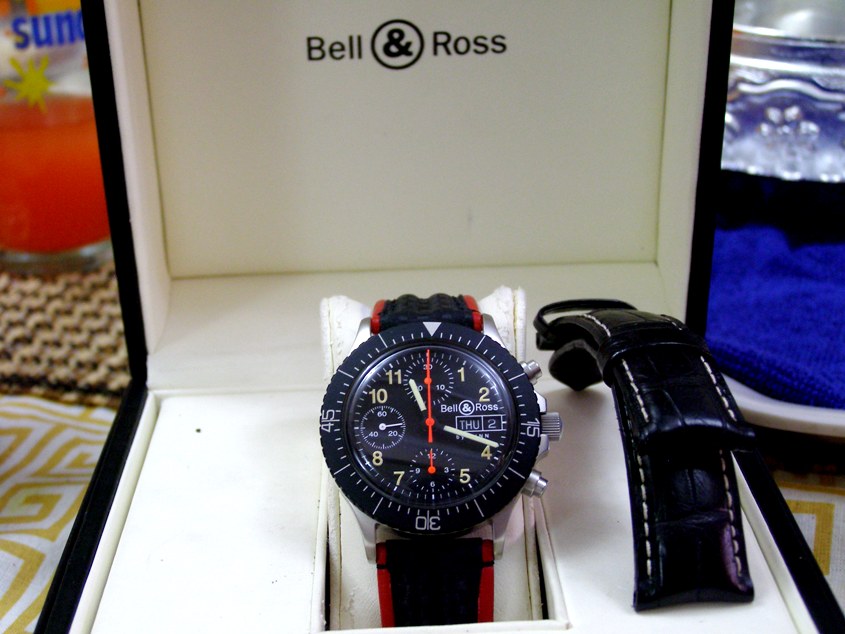
    AUTHENTIC BELL & ROSS BY SINN CHRONOGRAPH 256 MILITARY DIVER GENTS WRISTWATCH


    BRAND/JENAMA: AUTHENTIC RARE BELL & ROSS CHRONOGRAPH 256 BY SINN GENTS WRISTWATCH

    MADE IN/BUATAN: GERMANY

    CIRCA/TAHUN: 1970's - S/N 256.1318

    MODEL: MILITARY DIVER 3 REGISTERS CHRONOGRAPH

    CRYSTAL/CERMIN: SAPPHIRE CRYSTAL

    MOVEMENT/ENJIN: 25 JEWELS AUTOMATIC WINDING MOVEMENT CAL. 7750

    DIAL COLOR: BLACK

    FUNCTION/FUNGSI: HOUR, MINUTES AND SECOND, DATE, 3 REGISTERS CHRONOGRAPH

    HANDS/JARUM: LUMINOUS HOUR & MINUTE HANDS AND RED CHRONO HANDS

    MARKERS/TANDA WAKTU: LUMINOUS ARABIC MARKERS

    CASING : TITANIUM

    LUGS: 22mm

    MEASUREMENT/UKURAN: 38mm DIAMETER INCLUDING CROWN and 42mm LUG TO LUG

    BEZEL: BLACK DUAL ROTATION DIVER BEZEL

    DITANDA/ENGARVED BACK CASING: -

    CROWN: ORIGINAL ROLEX 1 STEPS SS CROWN WITH RARE SWISS + MARKING

    STRAP/TALI: ORIGINAL BELL & ROSS BLACK LEATHER BAND

    SIZE STRAP/SAIZ TALI: 8.5" FULL LENGHT

    DISCONTINUED BELL & ROSS BY SINN MODEL... RARE MINT DIAL! COME WITH ORIGINAL OUTER AND INNER BOX

    EXCELLENT CONDITION, KEEPING GOODTIME AND RECENTLY SERVICED

    PRICE: PERSONAL COLLECTION. MARKET VALUE FOR THIS PREOWNED WATCH IS RM7500 (TRY YOUR LUCK, I MIGHT SELL IT)


    Bell & Ross is an American watch company headed by Swiss designers Bruno Belamich and Carlos A. Rosillo. The brand was launched in 1992. The first watches were designed by Belamich and Rosillo when they designed for German watchmaker, Sinn.

    Watches produced under B&R, after Belamich and Rosillo left Sinn, such as the BR Instrument have been designed to replicate the shape of a cockpit instrument taken from an aircraft. The BR02 range caters for diving professionals through the use of highly legible dials and cases water resistant to withstand 1000 metres of pressure.

    Bell & Ross's first watches were virtual re-issues of Sinn models and carried the Bell & Ross logo as well as Sinn's. The partnership ended in 2002, when Bell & Ross began its own independent production in their facilities La Chaux-de-Fonds, Switzerland.

    The aesthetic appeal of Bell & Ross is mirrored in their four design principles, namely optimal water resistance, highly accurate Swiss mechanical movements, clear visual indicators, such as those found on aircraft instrument panels, and special functions intended for specific uses.

    Saturday, August 20, 2011

    LIMITED EDITION SOLID SILVER 30 MICRONS EBERHARD TRIPPLE DATE MOON PHASE CHRONOGRAPH


    HIGHLY COLLEC TABLE AND HARD TO FIND EBERHARD & CO TRIPLE DATE MOON PHASE CHRONOGRAPH GENTS WRISTWATCH - 1ST CHRONOGRAPH RE-ISSUE

    WHITE PORCELAIN DIAL

    CRYSTAL IS CLEAN WITH NO CRACK OR SCRATCHES

    SOLID 825 SILVER WITH GOLD PLATED 30 MICRON CASE

    ANTIQUE POCKET WATCH STYLE CASE (SEE PHOTOS)

    THE 25 RUBIES EBERHARD & CO MANUAL WINDING COMPLICATED MOVEMENT

    LUMINOUS BLACK HANDS

    BLACK ARABIC MARKER

    CASE MEASURES APPROXIMATELY 39mm EXCLUDING THE CROWN/PUSHERS AND 43mm LUG TO LUG

    DISCONTINUED LIMITED EDITION RE-ISSUE MODEL... VERY VERY RARE!

    EXCELLENT CONDITION AND KEEPING TIME. CHORONOGRAPH IS WORKING, RESET TO ZERO

    PRICE : RM8,500.00 (NEGOTIABLE)


    EBERHARD & CO IS ONE OF VERY EXPENSIVE WATCHES. LOG ON TO EBERHARD & CO OFFICIAL WEBSITE TO SEE IT YOURSELF WIDE RANGE OF EBERHARD & CO WATCHES


    HISTORY OF EBERHARD & CO WRISTWATCHES

    George-Emile Eberhard, the founder

    The Eberhard & Co manufacture was founded in La Chaux-de-Fonds, the historic birth place of watch-making industry by George-Emile Eberhard. Eberhard was the son of a prominent Bernese family tracing its origins back to the 10th century which has become instrumental in the development of the Swiss watchmaking industry. His father early initiated him to the art of watch making and Eberhard was only 22 when he founded the company.

    1900-1947

    In 1907, the company has become one of the largest swiss watch manufacture and inaugurated its new headquarters which takes an entire block at the very center of rue Leopold Robert, La chaux-de-Fonds's main avenue. The Parisian-like five-stories building was designed in distinctive Beaux Arts style with a round tower topped by an impressive eaglescuplture has become one of the city's wellknown landmark and its highest construction until the 1960s. In 1919, Eberhar's sons, George and Maurice took over the company. During the 1930's, the brand designed some of the most modern and innovative watches of the time such as the very first chronograph with self-winding movement in 1930, the first featuring a stop and start again buttons in 1935, the first wrist-watch with counter device in 1938 and the first double timekeeping chronograph of 1939.

    1947-1987

    After the end of World War II, the manufacture resumed its activities and, in 1947, made its first woman's watch, starting its jewellery collections. The brand continues its innovations: in 1950 it launched the Extra fort (Extra strong) with a single button to start and stop the chronograph, in 1960 it launched devises with simultaneous date setting, in 1968 its chronometers performed 36.000 vibrations per hour, making them among the most precise in the world, in 1980 it is the first Swiss Watch company to re-introduced mechanical chronographs in the market. In 1987, Eberhard & Co celebrates its centenary.

    1987 - NOW

    Since 1996, the manufacture has decided to focus on luxury king-size wrist watches and launched a new Grande Taille (Super Size) collection. True to its history of technical challenges, Eberhard & Co launched in 1997 the 8 days "a manually winding mechanical watch that needs to be rewound every eight days only" thanks to a special winding device and, in 2001, it launched the Chrono 4 "the first chronograph in the history of watchmaking whose counters are arranged in one row". In 2007, the brand celebrated its 120th anniversary.

    Friday, July 29, 2011

    COLLECTION OF VINTAGE MANUAL WINDING CHRONOGRAPH GENTS WRISTWATCHES II

    1. POLJOT STRELA COSMONAUT - 19 JEWELS CAL. 3017 - RM1300

    2. SEKONDA STRELA AVIATOR COSMONAUT - 19 JEWELS CAL. 3017 - RM1800

    3. LE JOUR - 17 JEWELS LANDERON CAL. 248 - RM1600

    4. NALPA - 17 JEWELS LANDERON CAL. 248 - RM1800

    5. AUREOL - 17 JEWELS - RM1400

    6. LANCET LARGE - RM2100

    8. IMPERIAL - RM1500

    9. HELBROS MILITARY - RM1800

    10. CLINTON - 17 JEWELS VENUS CAL. 51 - RM1600

    11. ACME - RM1400

    12. GIDANDET - 17 JEWELS - RM2,300


    13. BULOVA DIVER CHRONO 600 METER 17 JEWELS - RM2,300

    14. DULUX - 17 JEWELS CAL. 248 - RM1300