WILL KEEP IT AS MY PERSONAL COLLECTION BECAUSE OF DIFFICULTY TO FIND AND RARITY OF THIS WATCH BUT I'M WILLING TO PART WITH IT FOR RM18,500 AND NON NEGOTIABLE
Wednesday, August 31, 2011
PREVIEW - EXTREMELY VERY RARE HIGHLY COLLECTIBLE OMEGA CHRONOGRAPH 2668CK CAL.321 GENTS WRISTWATCH
WILL KEEP IT AS MY PERSONAL COLLECTION BECAUSE OF DIFFICULTY TO FIND AND RARITY OF THIS WATCH BUT I'M WILLING TO PART WITH IT FOR RM18,500 AND NON NEGOTIABLE
Saturday, August 27, 2011
RARE COLLECTION - ROLEX OYSTER PERPETUAL 6285 BUBBLEBACK GENTS WRISTWATCH
BRAND/JENAMA: AUTHENTIC VINTAGE ROLEX OYSTER PERPETUAL BUBBLEBACK GENTS WRISTWATCH
MADE IN/BUATAN: SWISS
CIRCA/TAHUN: 1953 - S/N 768416
MODEL: OYSTER PERPETUAL BUBBLEBACK MODEL 6285
CRYSTAL/CERMIN: ACRYLIC
MOVEMENT/ENJIN: ROLEX 25 JEWELS AUTOMATIC WINDING MOVEMENT CAL. 1235
DIAL COLOR: CREAM WHITE DIAL
FUNCTION/FUNGSI: HOUR, MINUTES AND SECOND. NO DATE
HANDS/JARUM: GOLD TONE DAUPHANE HANDS
MARKERS/TANDA WAKTU: RAISED GOLD TONE ARROWHEAD MARKERS
CASING : SOLID STAINLESS STEEL/ KELULI SEPENUHNYA
LUGS: 18mm
MEASUREMENT/UKURAN: 38mm DIAMETER INCLUDING CROWN and 42mm LUG TO LUG
BEZEL: SS BEZEL
DITANDA/ENGARVED BACK CASING: -
CROWN: ORIGINAL ROLEX 1 STEPS SS CROWN WITH RARE SWISS + MARKING
STRAP/TALI: BLACK LEATHER BAND
SIZE STRAP/SAIZ TALI: 8.5" FULL LENGHT
DISCONTINUED ROLEX MODEL... RARE MINT DIAL!
EXCELLENT CONDITION, KEEPING GOODTIME AND RECENTLY SERVICED
PRICE: PERSONAL COLLECTION. MARKET VAKLUE FOR THIS WATCH IS RM7500 (TRY YOUR LUCK, I MIGHT SELL IT)
LIST RM7,500 SOLD:RM
A History of Rolex Watches
Hans Wilsdorf founded the company we now know as Rolex in 1905. Born in Kulmbach, Germany in 1881, the company, Wilsdorf & Davies, was based in London. By 1908 it had become one of the leading watch companies in the UK. It was in this year that he coined the name Rolex.
Official Chronometer Certification was awarded to Rolex in 1910 from the "Bureau Officiel" in Switzerland, the first time this had ever been given to a wristwatch. This was to be the first of many accolades awarded to the watch, including the Class A Precision from the Kew Observatory in 1914.
In 1926 the Rolex Oyster was released. It was the first wristwatch to be considered waterproof, proven a year later when the watch was worn by the swimmer Mercedes Gleitze in his successful bid to cross the English Channel. This was beneficial to Wilsdorf whom had sponsored the event and gained considerable exposure for his new Oyster Watch. Wilsdorf recognized the importance of advertising and marketing his creation in order to gain publicity and prestige. 1931 saw the creation of the Perpetual Rotor, a mechanism now seen as the basis for self-winding movements. In the following years Rolex released the first Oyster Perpetual Lady-date (1954) the GMT Master with dual time zone function (1955) and the first Day-Date (1956).
Andre Heiniger took over the company following the death of Hans Wildorf on 06 July 1960. Rolex continued to invent and innovate in terms of technical skill and style throughout the 2nd half of the century. The Sea-dweller (1967) was certified as reaching depths of up to 1,220 meters making it the choice for Professional Divers - a point that was quickly adopted in advertising the model. The Explorer II (1978) and Cosmograph Daytona (1988) were also released to international waiting lists securing Rolex as one of the worlds most prestigious watch brands.
Rolex Dateline
- 1905 - Hans Wildorf establishes a London firm specialising in the distribution of watches.
- 1908 - Wildorf coins a brand name in which to sign his creations: Rolex.
- 1910 - In Switzerland, Rolex obtains the first official chronometer certification ever awarded to a wristwatch.
- 1914 - The Kew Observatory in Great Britain awards the Rolex wristwatch a CLASS A precision certificate.
- 1926 - Rolex develops and patents the first airtight, dustproof and waterproof watch - named the Oyster.
- 1927 - The Rolex Oyster crosses the English Channel unscathed.
- 1931 - Birth of the Perpetual Rotor, a self winding mechanism later found in every modern automatic watch.
- 1945 - The Oyster Datejust is invented. The first watch to display the date automatically.
- 1953 - Rolex has created the diving watch of reference - the Submariner.
- 1954 - The Oyster Perpetual Ladydate is introduced.
- 1955 - The Oyster GMT Master is designed making it possible to read the time in any two time zones.
- 1956 - The Oyster Day-Date is created.
- 1960 - The so called Bathyscaphe is created and plunges 35,787 feet into the Mariana Trench in the Pacific Ocean.
- 1967 - The Oyster Sea-Dweller is invented - waterproof to a depth of 610 m / 2001 ft.
- 1971 - The Oyster Explorer II is designed.
- 1978 - The Oyster Perpetual Date Sea-Dweller is tested waterproof to a depth of 1220 m / 4003 ft.
- 1988 - The first Cosmograph Daytona is fitted with a perpetual rotor.
- 1992 - A new model is added to the Professioanl range - the Yacht-Master.
- 2004 - Submariner celebrates its 50th Anniversary. Rolex celebrates with a special commemorative model with a green bezel and unique black dial.
Friday, August 19, 2011
VERY RARE LE COULTRE SUB SECOND CLAW LUG GENTS WRISTWATCHS
Movement- LeCoultre, manual wind by Vacheron Constatin which clearly marked VXN on the movement
Caliber- 480/CW
Case- 10K Rolled Gold Top, 32mm (not including crown), 41mm lug to lug, 17mm between lugs, Dial- Two tone Champagne, signed LeCoultre (with logo),
Crown- Rolled Gold
Serial Number- 1144033
PRICE - RM2.2K NEGOTIABLE
HISTORY OF VACHERON CONSTATIN (VC) AND JAEGER-LECOULTRE (JLC)
1938 after years of close cooperation, LeCoultre takes a partial ownership position, and a Jaeger-LeCoultre marketing alliance is formed.
Jaeger's Swiss sales organization were moved into the VC business address in Geneva
1940 George Ketterer, through SAPIC, takes a majority shares position in VC. Ketterer was Managing Director at SAPIC, which was the holding company for Le Coultre, Jaeger-Le Coultre, and a majority shareholder of VC; he was also a Manager in VC. There was a Ketterer in charge at VC - either George or his son Jacques - until 1987.
1940-1950's VC's operational role became etablisseur to LeCoultre's manufacture
1944 The caliber 2003 is announced - 1.64mm thinnest manual wind in history - by AP, and VC participates in a similar announcement.
1946 AP ships the finished Ultra Thin based on the cal. 2003 (AP company literature, No. 1, 2000)
1950's US importer was VC-Le Coultre, which was itself a division of Longines Wittnauer Watch Co
1955 VC 200 year bicentennial -
VC releases Ultra Thin announced in 1944 as a 200 year anniversary piece. Vacheron claim several advanced features not claimed by AP for the cal. 2003, including unique escapement and regulator innovations, which allowed for the elimination of shock protection and the elimination of adjustment normally required after cleaning and lubrication.
VC presented to Bulganin (Soviet Union), Eden (Great Britain), Eisenhower (USA), Faure (France)
1965 George Ketterer left Jaeger LeCoultre and went to head VC, thus separating the LeCoultre ownership connection.
Saturday, August 6, 2011
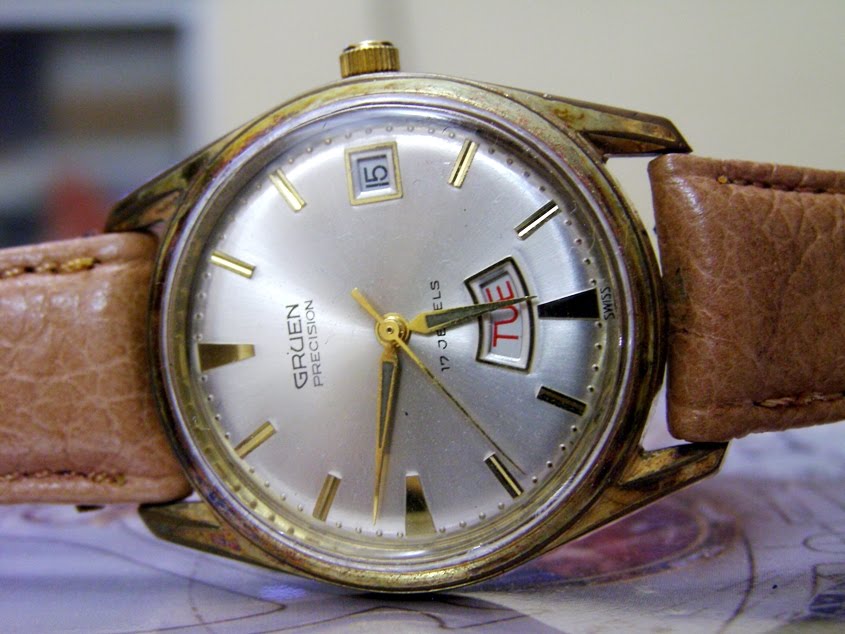
RARE SWISS MADE GRUEN GENTS MANUAL WINDING WRISTWATCHES COLLECTION


BRIEF HISTORY OF GRUEN WATCHES
The first Gruen watches are of very high quality and are beautifully made. Both 18 and 16 size versions were manufactured, each in both open face and hunter styles, and in 18- and 21-jewel versions. The earliest D. Gruen & Son serial numbers started around 62000. The Gruens dealt directly with individual jewelry stores; there were no wholesalers or jobbers involved in the distribution of their watches. 
In 1898 George Gruen joined the firm as treasurer and financial officer. The company incorporated and its name changed to D. Gruen, Sons & Company.
In 1903 Gruen introduces its "VeriThin" line of watches.
In 1908 Gruen introduced both men's and women's wristwatches. These proved popular only with women. Gruen was one of a very few companies to take wristwatches seriously this early, seeing their potential in spite of disappointing early sales to male customers.
Gruen made both wrist and pocket watches for the military during World War I. Most had silver cases, which would tarnish but would not corrode under adverse conditions. To satisfy U.S. military regulations, these watches all have luminous dial markings and hands.
1911 Dietrich Gruen dies suddenly. Fred Gruen takes control of the company.
In 1913 the company purchased Nanny Goat Hill, a pasture just outside of Cincinnati, and renamed it Time Hill. Work began on a new building designed by architect Guy C. Burroughs at a construction cost estimated at $50,000 USD. The company moved to the new location in 1917.
1921: Gruen introduces The Cartouche wrist watch calling it "The logical wrist watch shape".
1922: Gruen introduces "The Pentagon" pocket watch. "the Croix de Guerre of American achievement"
Up until 1922 there had actually been three Gruen companies: D. Gruen, Sons & Company; The Gruen National Watch Case Company of Cincinnati; and The Gruen Watch Manufacturing Company of Biel, Switzerland. In 1922 all three businesses were merged to form the Gruen Watch Company, with Fred as President.
In 1924, Gruen released a special pocket watch in an edition of 600 to commemorate their 50th anniversary. The watch cost $500 at the time.
In 1925, Gruen introduced the men's Quadron. These were rectangular watches containing very high-quality 15-j or 17-j tonneau-shaped movements.
In 1928 Gruen releases The Techni-Quadron. The famous Techni-Quadron "doctor's watches" are so-called because the large seconds dial was handy for timing a patient's pulse.
In 1935 Fred Gruen, now 63 years old, became Chairman of the Board and Benjamin S. Katz was brought in as President of the Gruen Watch Company. In 1935, Gruen was about $1.8 million USD (roughly $36 million USD today) in debt; nervous stockholders and investors were behind the change. Fred would retire in 1940, but continued to sit on the board for the rest of his life.
In 1935 Gruen introduces the most famous Gruen wristwatch- "The Curvex". These watches are one of the greatest examples of 1930s streamlined design.
1937: Gruen introduces "The Ristside" or "driver's" watches.
In 1938, continuing the success of their VeriThin pocket watches, Gruen also launched a series of Veri-Thin wristwatches. Contemporary Curvex and Veri-Thin movements often are closely related, and can share many parts. By the 1940s, most Gruen wristwatches were either Veri-Thin or Curvex models.
Although Gruen did not manufacture watches for the U.S. military, they offered the public a collection of eight military-style watches, to be used as personal watches.
In 1949, the company introduced their first watches made entirely in the U.S., a line of 21-jewel men's models called the "Gruen 21". The movements are marked "Cincinnati" or "US" instead of the usual "Switzerland."
Fred Gruen retired in 1940 and died in 1945, and his brother George died in 1952. In 1953 the Gruen family sold their interest in the company. The same year, Gruen president Benjamin Katz was forced into retirement after a scandal, and in 1954 the company bought out his shares for $2 million USD.
In 1953, the Gruen Watch Company had its highest sales in its entire history.
The Myth about Gruen, Rolex and Aegler - The True History
One of the most deeply-held myths about Gruen is that Gruen and Rolex at one time manufactured movements for each other's watches. Both firms did use some of the same movements—the best known examples are the Gruen Techi-Quadron and its twin, the Rolex Prince. In reality, these movements were manufactured by a third company, Aegler, who was a very close neighbor to the Gruen Precision Factory.
Above: The Aegler factory in Biel. Aegler made movements for Rolex (which had no manufacturing capability at the time), and this building is the main Rolex factory today. Aegler was partly owned by Gruen.
Gruen and Rolex were Aegler's biggest customers, and were both large shareholders as well—the full company name at one time was, Aegler, Societe Anonyme, Fabrique des Montres Rolex & Gruen Guild A. Gruen and Rolex both occasionally showed pictures of the huge Aegler factory in their advertising, making the implication that this was a Gruen- or Rolex-owned facility, although ownership at the time was divided among Gruen, Rolex and Aegler itself. Gruen sold their Aegler shares in the 1930s, after they moved all production to the Precision Factory. After this time, Aegler became increasingly tied to Rolex through the sale of stock. Today, the main Rolex building in Biel is the old Aegler factory, and though it is now owned by Rolex, it is still run by the Aegler family.This article taken from Complete Price Guide to Watches, American Wriswatches, Rolex Wristwatches: Best of Time and Gruen Master Book